About Markings Indicated on Wheels
| Q1: |
What are the JWL and JWL-T marks? What does the VIA mark mean? |
| Q2: |
Can we label with VIA marks or limited load marks on our own authority? |
| Q3: |
What is the difference between Max Load labeling and the VIA limited load labeling on imported wheels? |
| Q4: |
What are limited use conditions and general use conditions? Why are they indicated in KG, not in kgf? |
| Q5: |
In the case of multiple type wheels with more than one installation specification and thus more than one load value to which testing is applicable, how should the limited use load mark be displayed? |
| Q6: |
Is a Multiple Type wheel, for which there are multiple installation specifications for one wheel, supposed to use a VIA limited-use-condition load labeling mark for each installation specification? We think it should be sufficient just to label with the max load symbol if the wheel has passed the strength test, but is this incorrect? |
| Q7: |
If we have approved testing equipment ourselves, can we display the VIA mark on products that have passed the tests in the relevant testing equipment? |
| Q8: |
If JWL, JWL-T and VIA marks cannot be placed on the front side because of the wheel design, is it permissible to place these on the reverse? |
| Q9: |
Why do multiple-type wheels for which there are multiple specifications for installation need to indicate each load symbol per different installation specification? |
| Q10: |
If VIA markings is a requirement on wheels to be sold outside Japan, since no Japanese standard is applicable therein, would it be acceptable to sell them with VIA markings without an actual VIA registration? |
|
| Q1: |
What are the JWL and JWL-T marks? What does the VIA mark mean? |
|
| A1: |
We will explain about the respective marks, and also answer about related matters as well.
| (1) |
About JWL and JWL-T marks |
Concerning light alloy disc wheels
Concerning light alloy disc wheels,
which are maintenance parts, to ensure quality and safety, the Ministry of Land, Infrastructure, Transport and Tourism (MLIT) has stipulated “Technical Standards for Light Alloy Disc Wheels for Passenger Cars” for wheels for passenger cars, and “Technical Standards for Light Alloy Disc Wheels for Trucks And Buses” for wheels for trucks and buses, and stipulate the requirements that must be fulfilled for quality and performance.
For these technical standards, it is determined that auto manufacturers and wheel manufacturers conduct testing by themselves, and for products that conform to the standards (self-accreditation), markings should be placed on parts that can be easily checked in the state where JWL (for passenger cars) or JWL-T (for trucks and buses) marks is mounted on the vehicle.
In model accreditation of automobiles and inspection of automobiles, as certification of light alloy disc wheels being in compliance with maintenance standards, labeling with JWL and JWL-T marks is indispensable.
Note that the JWL is a mark made based on the words “Japan Light alloy Wheel”
|
| (2) |
About the VIA mark |
As confirmation of compliance under Paragraph (1) above with technical standards, this is voluntary accreditation, and safety of quality is relevant to human life so the Japan Light Alloy Automotive Wheel Testing Council (the “Council”) has set up a registration system for light-alloy disc wheels for domestic market sales (for the after-market) from the third party standpoint (the “VIA registration”).
For registration, verification test is conducted based on technical standards provided by MLIT, and judgment and assessment in accordance with the Japan Light Alloy Automotive Wheel Testing Council Regulations (the “Council Regulations”) are performed, and products that comply with the Council Regulations are registered.
Only products that undergo VIA registration may be marked with the VIA Mark.
The Council consists of three organizations, that is, “Japan Aluminum Association (JAA)”, an organization relevant to manufacturing of light-alloy disc wheels, “Nippon Auto Parts Aftermarket Committee (NAPAC) JAWA Division,” an organization relevant to sales thereof, and “Japan Vehicle Inspection Association” (“Vehicle Inspection”) , a third party testing institution, and testing and registration operations are carried out by Vehicle Inspection.
|
The VIA mark is a registered trademark of Vehicle Inspection, and it is possible to affix it only to products registered with the Council.
In addition, the JWL, JWL-T Mark and VIA Mark are applicable in Japan.
 |
 |
|
| Q2: |
Can we label with VIA marks or limited load marks on our own authority? |
|
| A2: |
VIA marks or limited load marking can only be displayed on products that comply with verification test conducted by the Vehicle Inspection and registered with the Council. In addition, VIA marks and load labeling marks must be used in the stipulated sizes and styles.
As the VIA mark is a registered trademark, displaying the VIA mark without VIA registration means unauthorized use of a registered trademark, and hence is illegal.
As specified in the Council regulations, unauthorized use will be handled by the following measures:
(1) Registration termination
(2) Elimination of the remaining quantity for documentary judgement
(3) Applications for new models are handled as specified in the Appendix of the Registration Application/Registration Bylaws.
|
| Q3: |
What is the difference between Max Load labeling and the VIA limited load labeling on imported wheels? |
|
| A3: |
Since the Council is incapable of knowing this, it is not possible to this question based on the kind of standard of Max Load labeling displayed on the imported wheel.
The VIA limited load mark can be displayed on products that have passed the standards as set forth under Test Condition 2 (limited use) found in a separate volume of the Council Regulations book and after VIA registration has been performed.
|
| Q4: |
What are limited use conditions and general use conditions? Why are they indicated in KG, not in kgf? |
|
| A4: |
Limited use conditions are testing conditions that are established for the heaviest wheel weights discovered in checking on the installation specifications of each vehicle hub.
And KG is a load labeling symbol and not a weight unit symbol.
General use conditions are to be set based on the load corresponding to its max load capacity and labeling with a load symbol is not required for general use.
|
| Q5: |
In the case of multiple type wheels with more than one installation specification and thus more than one load value to which testing is applicable, how should the limited use load mark be displayed? |
|
| A5: |
We will give an explanation using the example of the passenger car wheel.
| (1) |
In the case where the nominal rim diameter is 15 inches with 4 or 5 holes and PCD being 114.3.
VlA 690KG
4×114.3 620KG
|
| (2) |
In the case where the nominal rim diameter is 14 inches with 4 holes and PCD being 100 and 114.3.
VlA 620KG
4×100 500KG
|
| (3) |
In the case where the nominal rim diameter is 13 inches with 4 holes and PCD being 100, 110 and 114.3.
VlA 500KG
4×110 325KG
|
| (4) |
In the case of the combination-use wheel for trucks and buses
In the case where the nominal rim diameter is 12 inches with 4 holes and PCD being 100, 110 and 114.3.
VlA P-360KG
VlA T-480KG
4×110 P-275KG
T-375KG
4×114.3 P-330KG
T-400KG
|
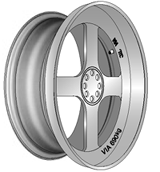 |
(According to the Test Conditions Chart, August 2012 version)
|
| Q6: |
Is a Multiple Type wheel, for which there are multiple installation specifications for one wheel, supposed to use a VIA limited-use-condition load labeling mark for each installation specification? We think it should be sufficient just to label with the max load symbol if the wheel has passed the strength test, but is this incorrect? |
|
| A6: |
If each of the installation specifications pass the strength test using the greatest load applicable for testing and mass load, labeling with the max load symbol alone is sufficient.
|
| Q7: |
If we have approved testing equipment ourselves, can we display the VIA mark on products that have passed the tests in the relevant testing equipment? |
|
| A7: |
Simply because a product has passed an internal inspection test does not mean it can be labeled with a VIA mark.
Application for VIS registration should be filed with documents attached with results of evaluation (test reports) using approved and registered testing equipment, and then only products that pass the verification test at Vehicle Inspection and in documentary judgment, and which are then are registered with VIA may be labeled with the VIA mark on the light alloy disc wheel.
|
| Q8: |
If JWL, JWL-T and VIA marks cannot be placed on the front side because of the wheel design, is it permissible to place these on the reverse? |
|
| A8: |
These must always be placed on the front of the light alloy disc wheel as per the Regulations. This is because these are supposed to be easily recognized by anyone when attached to the vehicle. It is necessary to take the position of labeling into consideration at the point of the design of the light alloy disc wheel.
|
| Q9: |
Why do multiple-type wheels for which there are multiple specifications for installation need to indicate each load symbol per different installation specification? |
|
| A9: |
This is because load strengths applicable in testing differ for each of the various installation specifications.
|
| Q10: |
If VIA markings is a requirement on wheels to be sold outside Japan, since no Japanese standard is applicable therein, would it be acceptable to sell them with VIA markings without an actual VIA registration? |
|
| A10: |
VIA marks can only be used on products registered with VIA on products that are sold for the after-market in Japan.
Even if a product is sold in a country outside Japan, the VIAs marking cannot be displayed on products that are not registered with VIA.
The VIA mark is a trademark of Vehicle Inspection, and penalties are applicable for unauthorized use.
|
|



